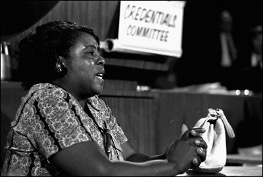
Approximately two months after Sims, on August 22, 1964, civil rights icon Fannie Lou Hamer, a leader in the Mississippi Freedom Democratic Party spoke before the credentials committee at the Democratic National Convention. In her televised speech, she recounted the violent opposition she encountered when attempting to register to vote and criticized Mississippi’s exclusion of Black Americans from the all-white Democratic Party.[i]
[i]See Janice D. Hamlet, “Fannie Lou Hamer: The Unquenchable Spirit of the Civil Rights Movement,” Journal of Black Studies, Vol. 26, No. 5, Special Issue: The Voices of African American Women in the Civil Rights Movement (May, 1996), pp. 560-576.
Fannie Lou Hamer’s 1964 testimony exposed the brutal reality of voter suppression in Mississippi, using her personal experience to challenge the legitimacy of an all-white political system. Her speech was powerful because it connected individual suffering to broader systemic injustice, forcing the nation to confront the gap between American democracy and reality. It also reinforced the demand for true political representation and voting rights during the Civil Rights Movement.
First hand events recalled by people who endured suffering need to be spread. It was fantastic, and surprising, that her memory was televised.
Experiences matter. This reminded me of the limitations of only one opinion ted-talk we watched in the first couple weeks of class. Her experience was not out of the ordinary, but the white people who sat in government positions never saw or experienced it themselves, therefore did not much about it. She showed the bravery that was required simply for black Americans to exist in America.
Her experience shows the bravery that was required from black people to access the most basic of their constitutional rights, that had so long been denied. Her phrase “Nobody’s free until everybody’s free” deeply resonates even with today’s fights for social justice, I remember seeing that phrase a lot during the organizing for Palestine.
Fannie Lou Hamer was one of the most powerful voices in the civil race regiment, especially around voting rights.
By recounting the beatings, arrests, and threats she endured simply for attempting to register to vote, she made it impossible for the Democratic Party to pretend that Mississippi’s all‑white delegation represented anything close to democracy. Her testimony challenged not only the state’s practices but the party’s willingness to seat a delegation built on racial exclusion.
Speaking just two months after Sims, she used national television to force the country to confront the violence, intimidation, and denial of political power that Black Americans in Mississippi lived with every day. Her testimony was not only emotional but politically significant, because it demanded that the Democratic Party reckon with its own role in upholding racial discrimination and consider seating the Mississippi Freedom Democratic Party as the true representatives of the state.
Hamer underscored what many of us knew, but had never said out loud: the Civil War Amendments lacked enforcement. By speaking at the Democratic National Convention, where her speech was televised, Hamer took her criticism directly to the political level. She challenged the legitimacy of Mississippi’s exclusion of African Americans from voting for/within the Democratic Party.
“In 1961, Hamer received a hysterectomy by a white doctor without her consent while undergoing surgery to remove a uterine tumor. Such forced sterilization of Black women, as a way to reduce the Black population, was so widespread it was dubbed a “Mississippi appendectomy.” Unable to have children of their own, the Hamers adopted two daughters.”
https://www.theguardian.com/world/2013/feb/28/ethiopian-women-given-contraceptives-israel
I am a bit surprised by Miss Hamer’s openness to speaking at and attending the Democratic National Convention, a convention which notably barely gave her the time of day and relegated her platform to a footnote upon its own. However, I appreciate that she spoke of the issues in the first place.
Fannie Lou Harmer’s advocacy consisted addressing the challenges and injustices faced by Black Americans in exercising their political rights within the Democratic Party.
Fannie Lou Hamer voiced her concerns about the clear exclusion of black individuals from voting and political rights, especially in regards to the Democratic Party.
Fannie Lou Hamer symbolized the Mississippi movement. Johnson did not want her testimony to be seen on live TV, so he called for a press conference to talk about a nine-year anniversary. However, his attempt to block her voice backfired as the news media talked about the interruption, day after day.
Fannie Lou Hamer is still admired today. One of her quotes “We are not free until we are all free” is something that strives me until this day to fight for equity and better opportunities for low-income neighborhoods, individuals, and families.